

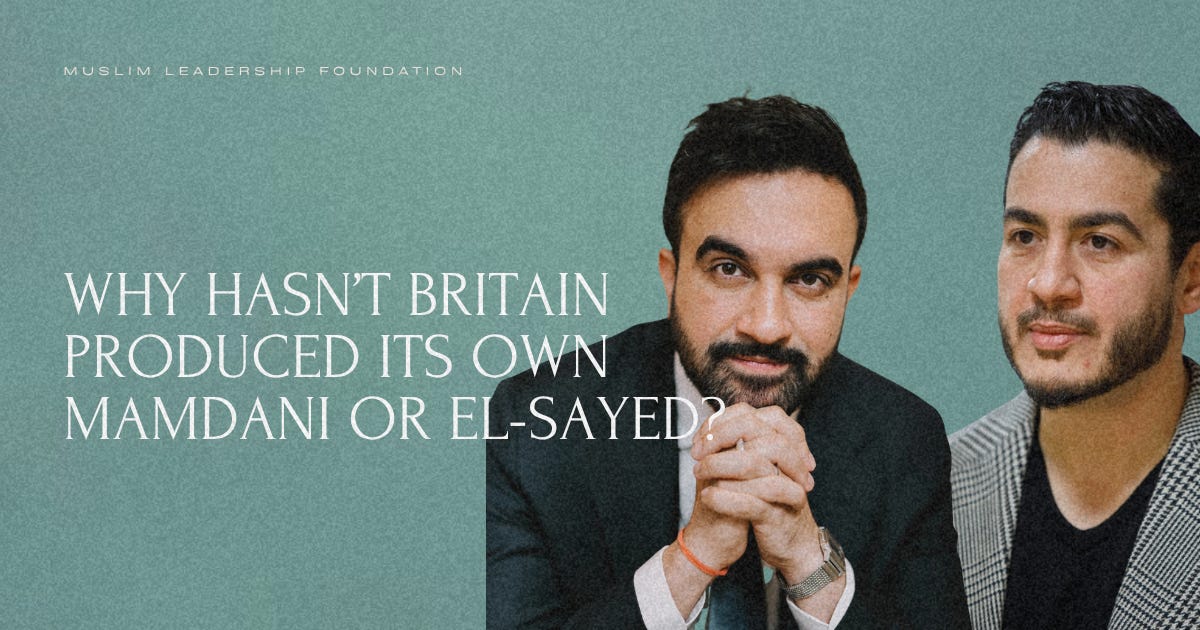
The success of Zohran Mamdani and Abdul El-Sayed has captured the imagination of British Muslims. It also raises a less comfortable question about what decades of Muslim political representation in Britain have actually produced.
Abdul El-Sayed’s victory in Michigan in the last 2 weeks travelled quickly across the Atlantic. His win in the Democratic Senate primary prompted celebration among British Muslims, and something more revealing too. Social media filled with comparisons to Zohran Mamdani, and the same question kept coming up: why don’t we have politicians like this?
The comparison is easy to understand. In a short space of time, two unapologetically Muslim politicians have pulled off victories many assumed were beyond them. Mamdani went from relatively obscure state legislator to Mayor of New York. El-Sayed, eight years after a failed run for Governor of Michigan, has beaten the Democratic establishment to become his party’s Senate candidate. If he wins in November he becomes the first Muslim senator in American history.
Both have spoken openly about their faith. Both have taken positions on Palestine that carry an obvious political cost in the United States. Neither has treated acceptability to the political establishment as the measure of success. But reducing their appeal to Muslim identity misses what’s most interesting about them. Mamdani did not win New York by promising better representation for Muslims. His campaign was relentlessly about rent, childcare, buses and the cost of living. El-Sayed has built his politics around healthcare, inequality and corporate power. They have persuaded large numbers of voters who neither share their faith nor particularly care that they are Muslim.
Watching from Britain, the contrast stings a little. This is a country with a far longer record of Muslims in high office. We have had Muslim cabinet ministers, party chairs, peers and mayors. Sadiq Khan has been elected Mayor of London three times by an electorate in which Muslims are a minority. Anyone claiming British Muslim politicians can’t win support beyond Muslims has to explain him.
It’s worth resisting the glamour of American politics too. We are picking two exceptional figures out of a country of 340 million and comparing them to an entire political class at home. America produces careerists and machine politicians on an industrial scale. Mamdani is already discovering that governing is far less romantic than campaigning, and El-Sayed still has to win a general election.
Even so, the question deserves to be taken seriously. The excitement around Mamdani and El-Sayed may have less to do with an absence of Muslim faces in British politics than with a growing dissatisfaction with the kind of politics we’ve settled for.
When representation stops being enough
For much of the past half-century, representation was the objective, understandably so. British Muslims were largely absent from Parliament and local government, and political parties often treated Muslim communities as voting blocs to be managed rather than sources of leadership. Getting people through the door mattered. Every first Muslim MP, minister or cabinet member chipped away at the idea that parts of British public life were simply not for Muslims.
That battle hasn’t disappeared, but its success has created a different one. There are now enough Muslims in British politics that counting them tells us relatively little. A community can have MPs without having much influence over the direction of the country. A politician can reach Cabinet without shifting the consensus around them, and the closer they get to power, the greater the pressure to prove they can be trusted not to disturb it.
British Muslim politics has become particularly good at producing two kinds of representation. One is the politician who learns how Westminster works, rises patiently through the ranks, and eventually acquires an impressive title. The other channels the anger of a heavily Muslim constituency, wins against the establishment, and arrives in Parliament free to say almost anything, with very little ability to make the government do anything. Proximity to power on one side, independence from it on the other. Neither is a particularly satisfying destination.
The first route is inseparable from how Westminster manufactures political careers. Constituents can make someone an MP; they cannot make them a minister. Advancement depends on the party leadership. Parliamentary private secretary, junior minister, shadow cabinet, Cabinet: each step requires weighing what the people controlling the next step will tolerate. Rebellion has a price. Patience is supposedly rewarded, eventually.
Some MPs spend years accumulating political capital for a promotion that never arrives. Those who make it into government often discover that having finally acquired something valuable, they now have even more reason not to risk it. Political capital gets banked indefinitely and almost never spent.
This isn’t a Muslim pathology. Westminster was producing ambitious careerists long before it admitted Muslims in any significant number. The problem is when Muslim communities mistake an individual’s advancement through that system for an increase in their own influence.
Any British Muslim MP confronted with the Mamdani comparison has a ready answer. Westminster isn’t New York. MPs belong to parliamentary parties, governments require collective responsibility, and a politician who rebels against every compromise quickly acquires plenty of admirers and very little power. All true. But the defence has a habit of becoming circular. The backbencher can’t take a risk because they hope to become a minister; the minister can’t because they hope to enter Cabinet; the cabinet minister can’t because they’ve finally acquired the influence they spent their career seeking. At some point it’s fair to ask what the influence was being saved for.
None of this requires British MPs to behave as if they’re in an American primary. The more useful lesson from Mamdani and El-Sayed is that political authority can be built outside a party hierarchy, not just granted from within one. An MP can spend a career developing ideas, organising around causes, building public support, and becoming associated with an argument that reaches beyond their constituency. They can try to change what their party believes rather than convincing its leadership they’re ready for promotion. British politics has produced plenty of figures, across the spectrum, who built constituencies of their own and forced established parties to respond. It’s simply a riskier route than waiting for advancement.
If the argument is that silence today buys influence tomorrow, there has to eventually be a tomorrow. After ten or fifteen years in Parliament, it’s fair to ask which argument was won, which policy shifted, which risk was finally judged worth taking. The constraints of Westminster are real. They can also become a convenient alibi for caution.
Shabana Mahmood’s career poses this question starkly. Her rise is remarkable. A Muslim woman of Pakistani heritage, elected in Birmingham in 2010, now holds one of the great offices of state. A generation ago, her becoming Home Secretary would have been almost unimaginable. By the measure of representation, this is success.
But Mahmood today is a markedly different political figure from the younger MP once associated with direct action over Palestine. In 2014, she was filmed protesting outside a Sainsbury’s in Birmingham, calling on the supermarket to stop selling goods from Israeli settlements. Eleven years later, as Home Secretary, she told the BBC that pro-Palestinian protests continuing in the days after the Manchester synagogue attack “felt un-British.” There are respectable arguments for a Home Secretary taking a harder line on public order than a backbench MP once did, including among Muslims, and no Muslim politician should be required to subscribe to a community-approved politics. Mahmood has every right to change her mind. Governing brings responsibilities, campaigning doesn’t. But it is a considerable distance to travel in a decade, and it is worth asking what carried her across it.
The harder question is why British Muslims should treat the fact of her ascent as politically meaningful in itself. A politician who reaches the summit of the state only to become an enthusiastic custodian of its prevailing instincts has delivered a symbolic achievement and a much less obvious political one. Has proximity to power let Mahmood’s politics shape the state, or has proximity to the state mostly reshaped her politics?
British politics also remains deeply uneasy with Muslim politicians whose Muslimness has political consequences. An MP who talks too often about Muslim concerns risks accusations of communalism. Relationships with Muslim organisations attract intense scrutiny. Palestine keeps becoming a test of political respectability. Ambitious politicians notice this. Independence from one’s community is essential for anyone who wants to govern a country, but there’s a difference between independence and having to continually prove one’s distance from it. The Muslim politician who travels furthest through the establishment may be the one who’s become best at reassuring it that their Muslim identity will cause the least inconvenience.
The alternative hasn’t worked particularly well either
It’s tempting to conclude that the answer is simply to abandon the established parties and elect politicians answerable only to their constituents. Recent British politics has tested that proposition fairly well.
The 2024 general election showed something important about Muslim political power. Anger over Gaza broke longstanding loyalties, particularly to Labour, and helped elect independent MPs in constituencies with large Muslim populations. Several established politicians discovered Muslim votes could no longer be assumed. For communities used to being courted before elections and disappointed afterwards, that was satisfying.
Punishing a party is a form of power. Converting punishment into influence is harder.
An independent MP can speak with a freedom denied to a government backbencher. They can table questions, organise campaigns, vote according to conscience, and use Parliament as a platform. All of this has value in principle. In practice, the 2024 intake of independents has achieved little of substance since taking their seats: plenty of speeches, few results. Five MPs, elected largely through geographically concentrated anger over one issue, were never going to determine the programme of a government with a large majority, and so far they haven’t come close.
If your political model can elect someone in Blackburn or Leicester but has almost nothing to say to voters ten miles down the road, its ceiling is built in from the start. You risk gaining representatives who express your anger with admirable clarity while the decisions you’re angry about continue largely unaffected.
For a brief moment, the attempt to build a new political force around Jeremy Corbyn and Zarah Sultana seemed to offer a way out of that cul-de-sac. Corbyn has something unusual in British politics: decades of trust among many Muslim voters, built through his positions on Iraq, Palestine, civil liberties and the treatment of Muslim communities. Sultana brought a younger audience and her own reach. Combined with the independent MPs, disillusioned former Labour voters and the wider economic left, there was at least the possibility of building something broader than a collection of local protest campaigns.
Instead, extraordinary early interest gave way, within weeks, to a straightforward power struggle over who would control the new party. It curdled into the kind of hard-left factional warfare Britain has seen many times before, and the project imploded before it had built anything to be factional about. Whatever survives of it, the episode should prompt some reflection about a political culture that gets exercised about who controls an organisation before establishing whether the organisation can control anything.
British Muslims should be especially wary of this trap. It’s a strange kind of consistency: criticising Muslim ministers for having power without independence, then celebrating an alternative politics with abundant independence and almost no power.
None of this means independents should never stand, or that Muslims should return obediently to Labour. Quite the opposite. The willingness to withhold votes has made Muslim voters harder to take for granted, and that’s healthy. But disruption should be the beginning of a strategy, not its conclusion. A permanent protest bloc, concentrated in a small number of constituencies and defined mainly by the issues on which Muslims feel betrayed, risks being emotionally satisfying and strategically marginal.
The politics of the cul-de-sac
Parts of British Muslim political organisation grew from the networks through which first-generation migrant communities established themselves in Britain. Family associations, mosques and connections to particular villages or regions in Pakistan and Bangladesh gave communities ignored by mainstream institutions a means of organising. They produced councillors, MPs and real local electoral influence.
But not every inheritance is worth preserving. In some places, factional relationships rooted in the politics of countries of origin have outlived the circumstances that created them. Family rivalries, regional identities and political interests in Pakistan or Bangladesh become entangled with local selections and campaigns in Britain. A machine that can deliver votes in a ward with a large Pakistani or Bangladeshi population may be very good at winning an internal contest while being almost useless at developing an argument for the country.
Faiza Shaheen is the clearest recent example of what this costs. She had already stood for Labour in Chingford and Woodford Green once, in 2019, narrowing a large Tory majority. In 2024, days before nominations closed, the party’s ruling body dropped her over old social media likes. She has since said she was penalised for describing her own experience of Islamophobia, and that the party operates a hierarchy of racism. She ran as an independent instead, and came third with just under 26% of the vote, 79 votes behind the Labour candidate who replaced her. It is not hard to imagine a version of Shaheen with Shaheen’s economics background, an LSE academic who has written seriously about inequality, built into a British Elizabeth Warren or a Lina Khan. Instead the party hierarchy decided the risk of keeping her wasn’t worth it, and may well have handed the seat away in the process.
The Mamdani and El-Sayed comparison is revealing here. Their backgrounds shape their politics, and both have drawn enormous energy from communities that recognise something of themselves in them. What they’ve avoided is letting those communities become the outer boundary of their political imagination.
Mamdani’s genius as a campaigner was to make an argument about New York in which Muslims could recognise themselves without requiring New Yorkers to recognise themselves as Muslims. A renter worried about another increase didn’t need to care about his faith to understand his politics. The same is true of El-Sayed on healthcare or corporate power. Their identities give texture to their political stories. Their programmes give them a way out of the confines of identity.
Too much of our Muslim politics oscillates between assimilation and communalism instead. One route asks politicians to prove their origins will make few demands on the establishment. The other produces representatives extraordinarily responsive to Muslim anger but with little incentive, or ability, to build a constituency beyond it. Neither solves the problem of national persuasion.
America has not discovered a magic formula
There are obvious reasons not to turn Mamdani and El-Sayed into political saints. American primaries create openings for insurgents, but they also operate inside a system deformed by extraordinary quantities of money. Lobbyists and wealthy donors wield enormous influence. Winning an election is routinely easier than changing an institution.
Mamdani now faces exactly that test. The qualities that made him an exciting candidate matter less than whether he can turn them into effective government. Budgets, unions, business interests and the everyday compromises of running a city impose constraints no campaign video can wish away. Some of his current admirers will be disappointed.
Still, the route by which he got power matters. Mamdani didn’t have to wait for senior Democrats to decide he’d been sufficiently loyal to deserve promotion. El-Sayed didn’t win Michigan because the Democratic establishment carefully ushered him through its ranks. They built constituencies capable of overcoming resistance from within their own political home. That gives a politician an independent source of authority, something Westminster offers far fewer opportunities to acquire. A British politician with Mamdani’s politics would first have to survive a party selection, then a parliamentary culture in which their prospects would depend heavily on the judgement of people with every incentive to find them troublesome. Some would survive that process. Others would learn to become less troublesome.
Westminster can’t carry all the blame, though. Muslim communities create incentives too. We complain that our politicians lack national appeal while evaluating them almost entirely on their positions on a handful of explicitly Muslim concerns. A politician doing serious work on housing, public services, poverty or economic reform can attract less attention than someone delivering a speech on Palestine. We can’t demand leaders capable of speaking to the whole country while rewarding them mainly for speaking back to us.
Muslim institutions have their own version of this temptation: confusing access with influence. The photograph with a minister, the invitation to Downing Street, the parliamentary reception, the stakeholder roundtable. All of it can be useful. None of it should be mistaken for power. The question that matters is what changed afterwards.
Political maturity doesn’t mean producing a standard Muslim position on every subject and punishing politicians who deviate from it. Britain should have outstanding Muslim Conservatives as well as socialists, liberals and Greens, disagreeing about immigration, taxation, policing, foreign policy and the size of the state. A community of millions should be politically argumentative. What should trouble us is politics with no larger purpose than advancement on one side, or permanent protest on the other.
What comes after representation?
Britain doesn’t need its own Zohran Mamdani or Abdul El-Sayed. Their politics belongs to the places that produced them, just as the leadership Britain needs will have to come from our own cities, institutions and arguments.
But there’s something worth learning from their success. A politician can be visibly shaped by Muslim identity without asking voters to elect them principally because they’re Muslim. A political base is somewhere to begin, not somewhere to remain.
That should be the ambition here. British Muslim politicians who can walk into a mosque and understand the room, then walk into a town where almost nobody is Muslim and make an argument that matters there too. Politicians who can talk about Gaza and housing, Islamophobia and the NHS, civil liberties and economic growth, without treating one set of concerns as authentic and the other as a stretch for broader appeal.
Some should come from the left, others from the right. What matters is whether they have a political project larger than their own career, and a constituency broader than their own community. Getting Muslims elected was an important achievement. Producing politicians capable of changing the country is a greater one.
El-Sayed’s victory has given British Muslims another American political figure to celebrate. The more useful response may be to ask why the comparison feels necessary in the first place.
And here’s a question for anyone tempted to dismiss all this as another case of British fascination with American politics. Imagine Zohran Mamdani had begun his political career here. Same convictions, same ambition, same Muslim identity, the same willingness to talk about Palestine and the same appetite for upsetting powerful interests. Put him through a British party selection, a parliamentary career, the machinery of Westminster advancement.
Would we have produced Zohran Mamdani?
Or would we have taught him to keep his head down and wait for a job?
Sayed Alkadiri
The answer to this is also the answer to why Britain hasn’t produced its own Hasan Piker, Amjad Masad, Kareem Rahma, or Lina Khan. Insular British culture produces insular British Muslims (Im saying this as dual national American Muslim in England). The Brits that have bucked this phenomenon (Mehdi Hasan, Tan France, Riz Ahmed) have just crossed the pond to become Americans instead. It's not about adapting to a political or cultural dynamic, it's about driving and reshaping it.
Assalamu alaikum, I would be wary of putting Zohran or any Muslim politician on a pedestal, which this piece feels like it is doing. They're not our community's saviors. Getting more Muslims in power doesn't necessarily mean they represent their ummah's best interests. Getting more of them in leadership doesn't necessarily mean success for Muslims. Sometimes, eventually, they are the ones selling us out (Obama did that to Black folks).
I don't blame you, we are a bit desperate for authentic representation, but we did this pedestal thing with Keith Ellison and Ilhan Omar, and much to your point, those two actually got us nowhere. They've become sell outs. Keith for his part never mentions Islam publicly anymore in his work and his politics have become basically secular/atheistic over the last decade. He is barely using his platform to amplify Palestine. Ilhan, I doubt she was ever a practicing Muslim and she has advocated policies that are simply not Islamic. So, what is their purpose, other than representation?
As an ummah we have to start getting more realistic and assertive about what we will accept from Muslim politicians in the West, and what we can expect from them. This is going to sound harsh, but I feel strongly we need to start asking them to stay in their lanes. They do not represent the ummah at large, and are absolutely not able to lead us or for us in an authentic way, due to the systemic situation they are in (the establishment), and also because, frankly Muslim politicans in the west seem to all be cultural Muslims at best, and looking at their policies and advocacy, closet atheists at worst. Allahu musta'an. The best work will continue to be agitation from the outside deeply rooted in community -- while demanding accountability, yes, even of our Muslim electeds.